
Rapides Parish Criminal Court Records
Criminal court records in Rapides Parish are maintained through the Rapides Parish Clerk of Court and the 9th Judicial District Court. The clerk's Criminal Department manages pleadings and filings in criminal matters, including felony, misdemeanor, juvenile, and traffic filings. The department also works with law enforcement, prosecutors, and other agencies, and it issues bench warrants, subpoenas, notices of bond forfeiture, victim notifications, and criminal court minutes.
The 9th JDC is the parish's general-jurisdiction trial court. It handles criminal proceedings along with civil, juvenile, family, and other district-court matters. Division B, Division F, and Division G are tied to criminal docket work in the research, while other divisions or lower courts can matter depending on a specific filing. The full criminal court file is broader than the charge list. For a closer look at the arrest-to-charge path, use the Rapides Parish arrest records and court charges page.
The Clerk Criminal Department page identifies the office duties behind Rapides Parish criminal court records.
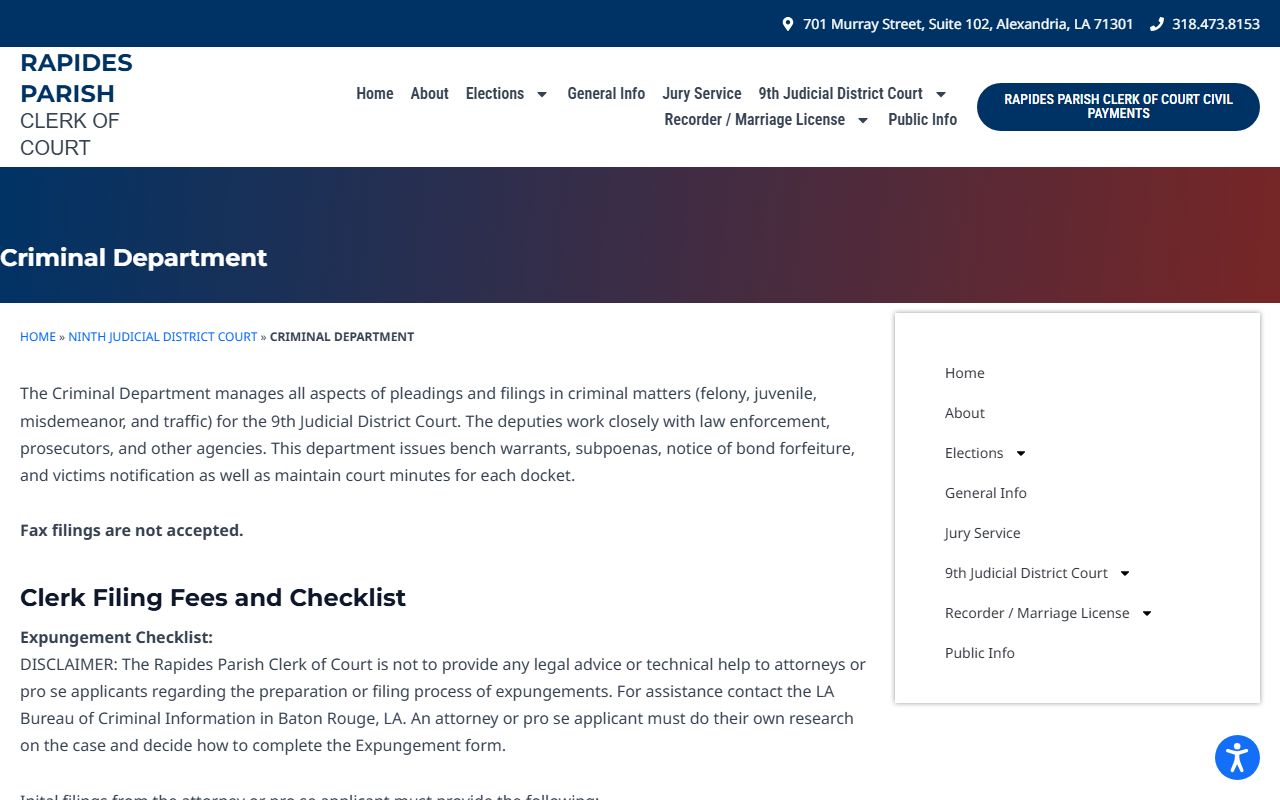
The clerk department is the key local source because it maintains filings and minutes after a criminal case opens.
Search Rapides Parish Criminal Cases
The main case-file search channel is the Clerk of Court's RAPID E-Search service, which is subscription based and login gated. It can provide online inquiry and redacted copy purchasing for much of the information available through public access computers in the clerk's office. It does not make online copies official. The clerk states that courthouse records control if the online record differs from the physical record.
- Start with the clerk's RAPID E-Search access page and review the online terms and limitations.
- Create or use a subscriber login through the linked RAPID E-Search portal.
- Search by the available case, party, or document index fields after login; the public page does not expose every search label.
- Review docket entries for arraignments, motions, pretrials, pleas, dispositions, sentencing, and minute activity.
- Request certified copies from the Rapides Parish Clerk of Court in person or by mail when a formal copy is needed.
Division docket pages can help find court dates, but they are not the same as criminal court records. A docket may show a felony motion date or revocation setting. The record file shows what was filed and what the court entered.
Rapides Parish Criminal Case Flow
A criminal case file grows as the case moves through the court. The charge may be filed by bill of information, indictment, misdemeanor filing, traffic matter, or other pleading. Later entries can show arraignment, pretrial motions, plea negotiations, trial settings, verdict, disposition, and sentence. Each stage can create a docket entry, minute entry, order, or filing.
Case flow: Charges Filed › Arraignment › Pretrial and Motions › Plea or Trial › Disposition › Sentencing
| Stage | What Happens |
|---|---|
| Charges filed | The prosecutor files a bill of information, indictment, misdemeanor filing, or related pleading that opens or advances the criminal case. |
| Arraignment | The defendant appears for a setting where charges are read and a plea may be entered. |
| Pretrial / motions | The court hears motions, readiness issues, discovery disputes, revocations, or other pretrial matters. |
| Plea or trial | The case resolves by plea, trial verdict, dismissal, or other court action. |
| Disposition / sentencing | The court records the outcome and any punishment, condition, sentence, or final order. |
The Division F criminal docket shows how Rapides Parish criminal settings can be posted by division.
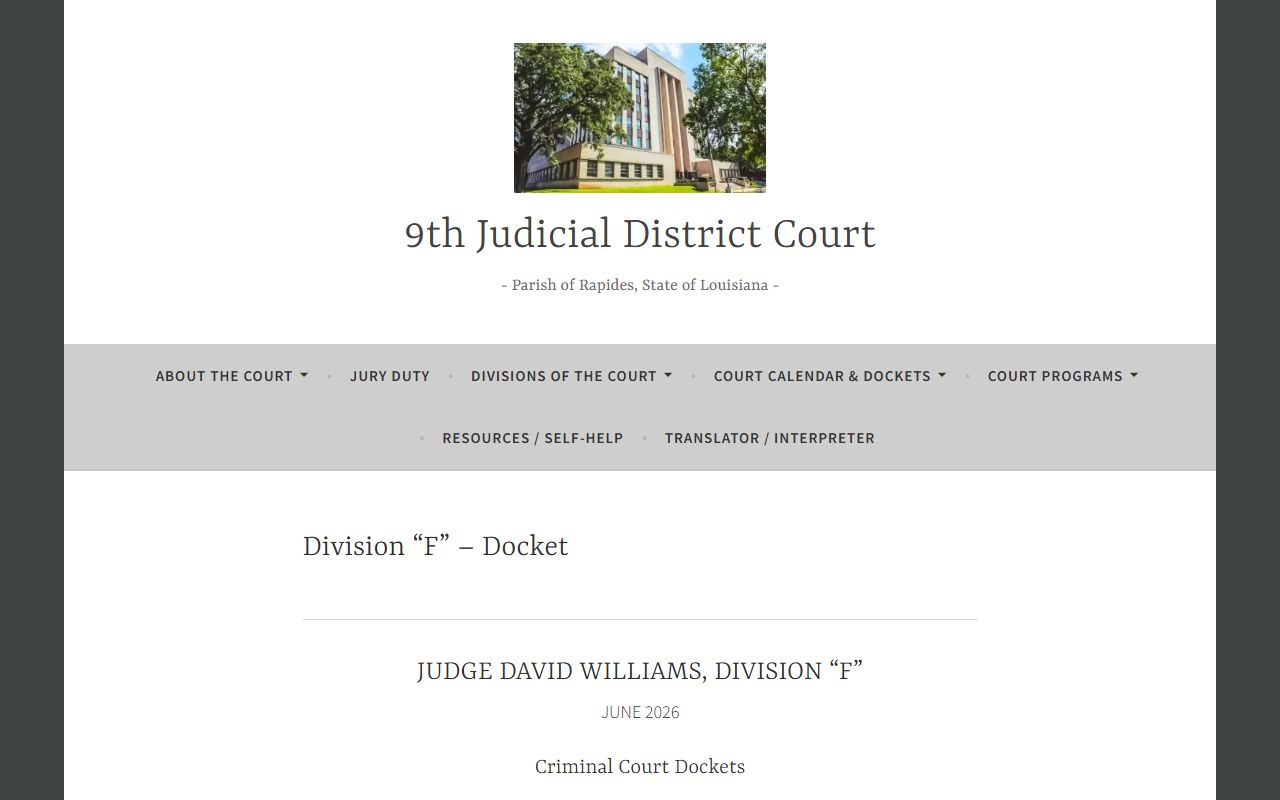
Criminal docket images help identify settings, but the Clerk of Court record is still needed for filed documents and outcomes.
What Rapides Parish Criminal Records Show
A Rapides Parish criminal court record can show the court division, defendant name, filing date, case type, judge assignment, charge, bill of information or indictment, warrant activity, subpoenas, bond forfeiture notices, plea, disposition, sentence, bond, victim notification, and criminal court minutes. It may also show revocation settings, felony motions, misdemeanor arraignments, and pretrial proceedings listed on division dockets.
| Field | What It Shows |
|---|---|
| Case number | The court file identifier when available; no public format was located in source pages. |
| Defendant | The person charged in the criminal case. |
| Charges | The accusation or count filed by the prosecutor or grand jury. |
| Charging document | A bill of information, indictment, or related pleading that states the formal charge. |
| Plea | The defendant's formal answer to the charge, such as guilty, not guilty, or another permitted plea. |
| Disposition | The outcome of the case or charge, including dismissal, plea result, verdict, or other resolution. |
| Sentence | The punishment, conditions, or court order imposed after conviction or plea. |
Charges vs Convictions
A charge is an accusation filed in court. A conviction is an outcome after a guilty plea, verdict, or other adjudication that supports conviction. Rapides Parish criminal court records can show charges that were amended, reduced, dismissed, or resolved in a way that is not a conviction. That distinction is critical when reading a docket, bond entry, press release, or case file.
| Point | Charge | Conviction |
|---|---|---|
| Stage | Accusation filed by prosecutor or grand jury | Final or adjudicated outcome after plea or verdict |
| Record signal | Charge description, count, information, indictment, or docket entry | Disposition, judgment, sentence, or minute entry |
| Meaning | Does not prove guilt by itself | Reflects a legally entered result |
| Can change | May be amended, reduced, dropped, or dismissed | May later be appealed, corrected, sealed, or expunged if legally eligible |
Note: A booking charge or arrest summary is not the same as a final court disposition.
Read Dispositions and Sentences
Disposition means the outcome of a case or charge. Sentence means the punishment or court-imposed condition after a conviction or plea. A Rapides Parish criminal case file may show both at different points. The docket may list a setting, while the minutes or judgment show the result.
Common record terms include plea, arraignment, revocation, pretrial, bond, bench warrant, subpoena, and minute entry. A bench warrant can appear when the court issues a warrant, often tied to failure to appear, bond conditions, revocations, or similar court problems. A subpoena is a command to appear or produce evidence. A revocation is a proceeding that alleges a violation of probation or another release term.
The RPSO criminal records request page covers law-enforcement records that may be related to a criminal case but are not the clerk's court file.
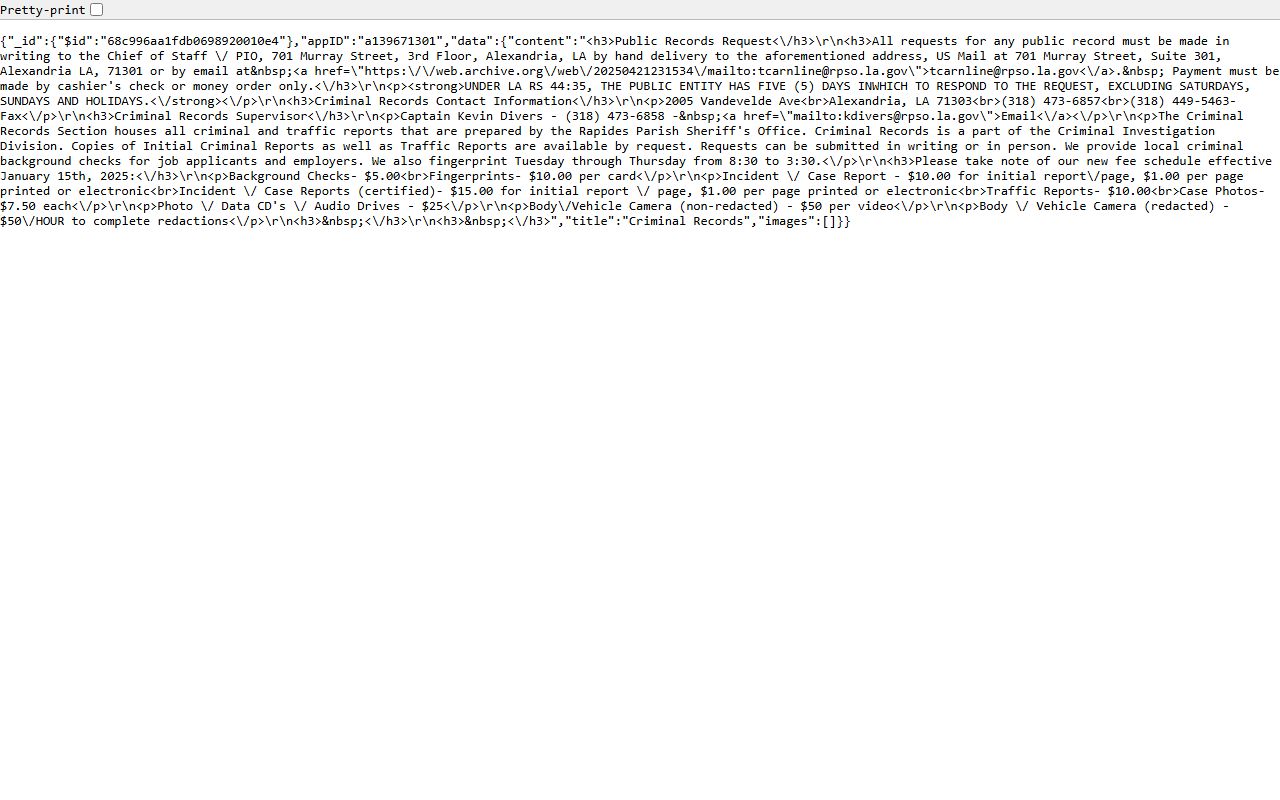
This distinction helps separate sheriff incident or report records from the criminal case file kept by the clerk.
Sealed vs Expunged Records
Sealed and expunged records are access categories, not proof that a case never existed for every government purpose. Louisiana criminal-procedure provisions govern expungement eligibility and effect. The research notes that expungement generally restricts public access to eligible arrest or conviction material, but it does not mean every government trace is physically destroyed in all contexts.
| Point | Sealed | Expunged |
|---|---|---|
| Public access | Closed from ordinary public view by law or court order | Restricted from public access after eligible relief is granted |
| How it happens | Statute, court rule, or judicial order | Petition and order under Louisiana criminal-procedure rules |
| Agencies involved | Court and custodian of the sealed file | Court, clerk, sheriff, district attorney, state police, and other custodians may need notice |
| Proof to keep | Certified copy of the sealing order | Certified copy of the signed expungement judgment or order |
Louisiana criminal expungement provisions provide the state-level framework for eligible criminal records.
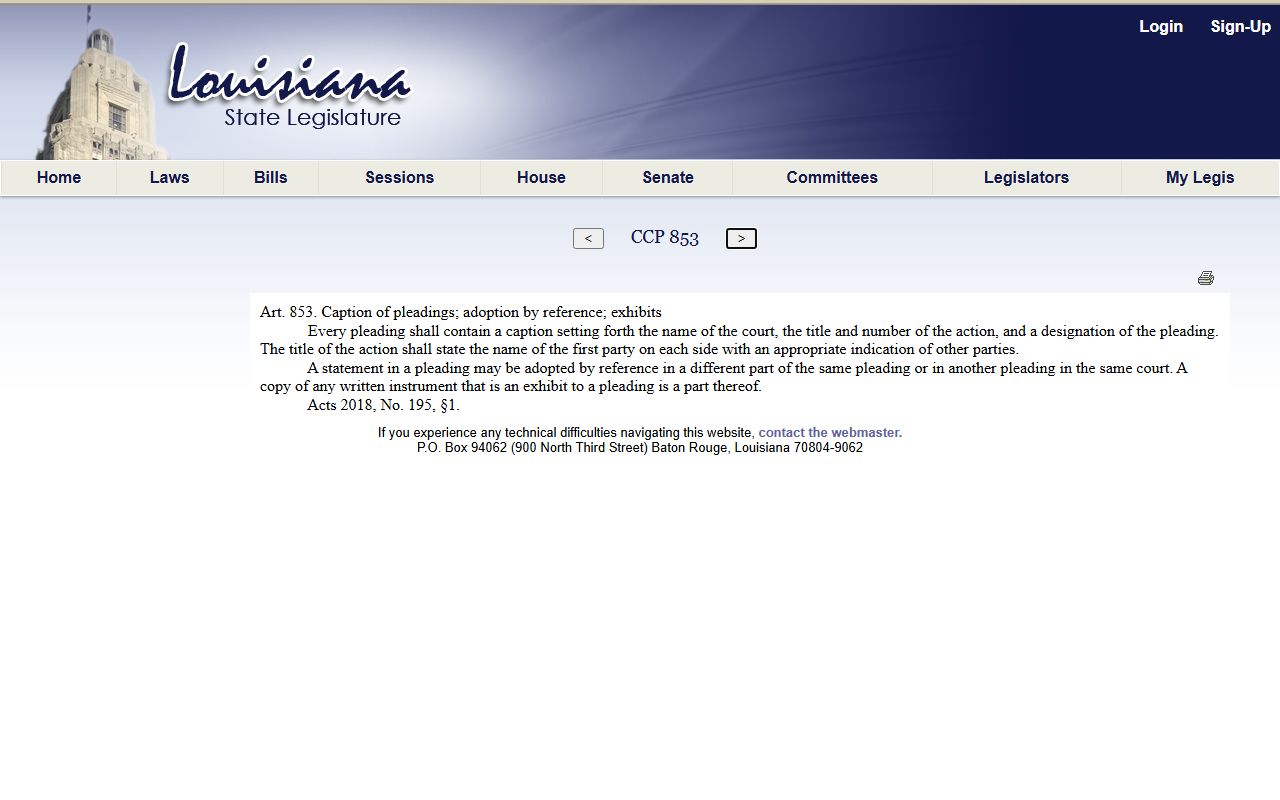
The statute image supports the practical point that expungement is a legal process, not a simple record edit.
Rapides Parish Criminal Record Access
Public access to criminal court records is shaped by Louisiana public-records law, court rules, and case-specific restrictions. La. R.S. 44:1 defines public records broadly, and La. R.S. 44:31 gives a right to inspect, copy, reproduce, or obtain public records except where access is limited. For a criminal court case, the Clerk of Court is the core records custodian.
Juvenile proceedings are a major exception. The 9th JDC Division E page states that juvenile proceedings are confidential and closed to the public, citing Louisiana Supreme Court Title V, Rule 42.3(a), except as otherwise provided by Children's Code Article 407. Adoption, judicial commitment, sealed, expunged, and personal identifier material may also be withheld or redacted.
RPSO official news releases sometimes describe arrests, warrants, charges, bonds, and active investigations.
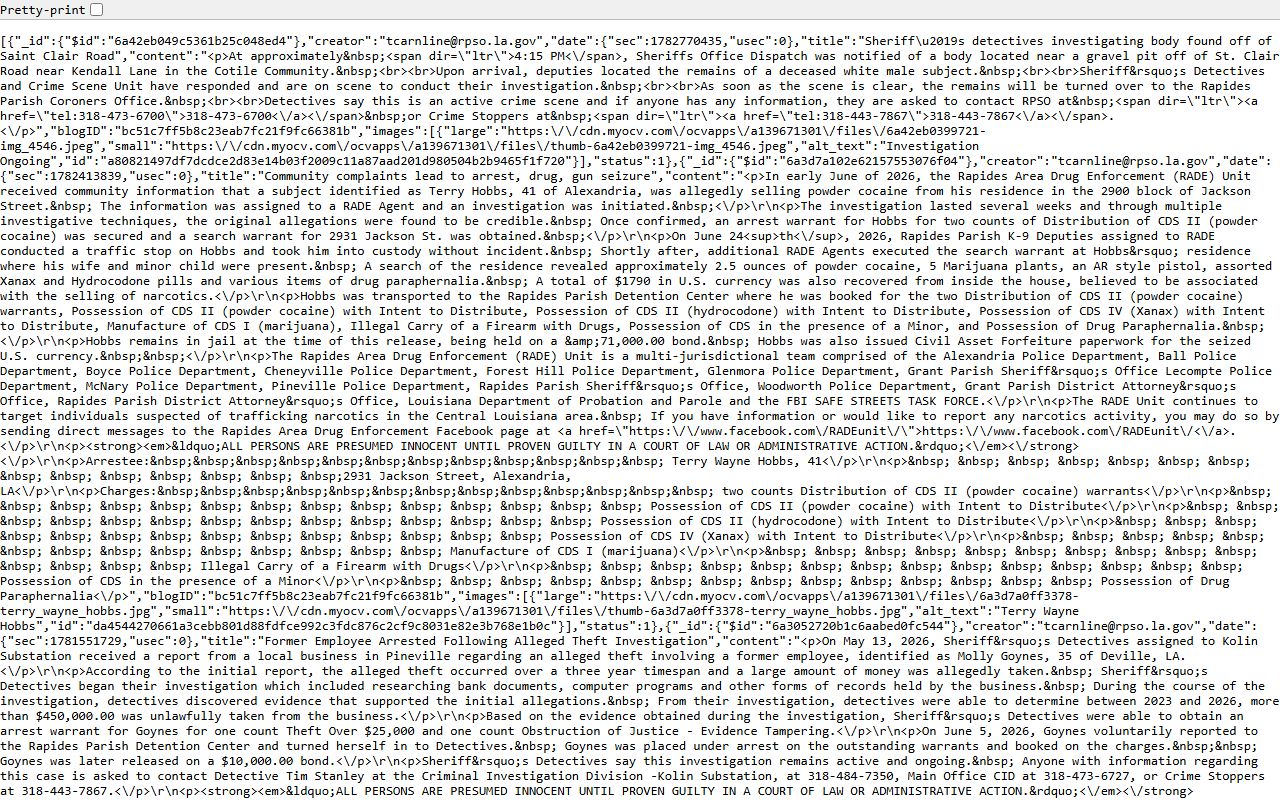
Press releases can explain how a case began, but the court record is needed for pleas, dispositions, and sentencing.
Request Rapides Parish Criminal Copies
For certified criminal court copies, contact the Rapides Parish Clerk of Court rather than relying on a docket page or sheriff summary. The clerk is at 701 Murray Street, Suite 102, Alexandria, Louisiana 71301, phone 318-473-8153. The office lists Monday through Friday hours from 8:30 AM to 4:30 PM, except legal holidays. The 9th JDC court office is in Suite 501 at the same courthouse.
Rapides Parish Clerk of Court
701 Murray Street, Suite 102
Alexandria, LA 71301
318-473-8153
For a law-enforcement incident report, traffic report, fingerprints, body camera material, or local background check, use the RPSO records request process. Those records may support criminal history research, but they are not the same as the district-court case record.